
How to Prioritize Work When Small-Business Capacity Is Limited
What to Protect When Capacity Is Limited
When time, money, and attention are constrained, the answer is not to treat every task as equally urgent. It is to protect the work that carries the most consequence.
There are periods in every business when capacity is simply limited.
The team may be small. A major project may be underway. Client needs may be overlapping. Revenue may be uneven. A key person may be unavailable. Or the founder may be carrying too many responsibilities that were never meant to live with one person indefinitely.
In those moments, it is tempting to respond with more effort, longer lists, and an expectation that everything must somehow still happen at the same level.
But capacity is not a character flaw. It is a real operating constraint.
It is also not only a calendar issue. When the gap between commitments and available capacity is carried by one person, it can become a wellbeing issue: longer hours, persistent mental load, reduced recovery time, and the sense that stepping away will cause something important to fall through.
Naming the constraint clearly is not an excuse to lower standards. It is how you protect the people, relationships, and work that matter from the consequences of trying to carry too much without a plan.
The work of leadership is not to pretend the constraint does not exist. It is to make better choices because it does.
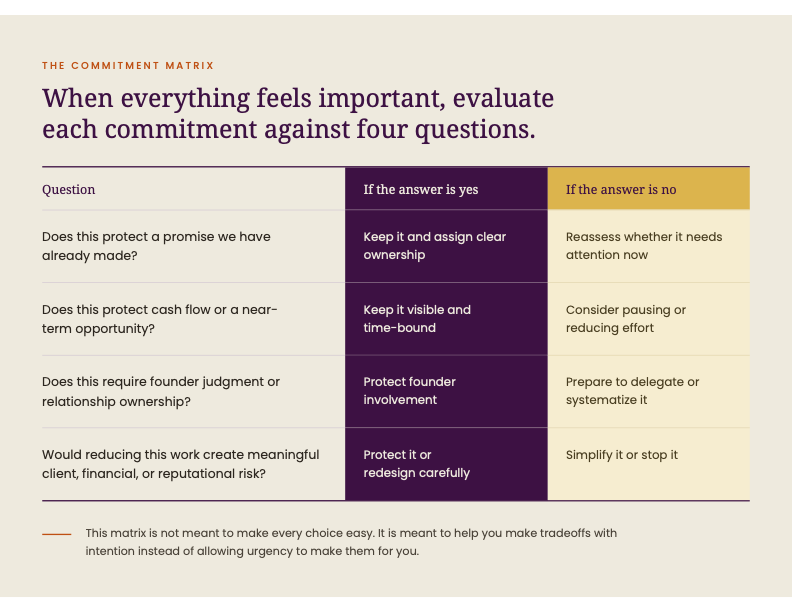
When capacity is limited, prioritization is not simply a productivity exercise. It is the practice of protecting the promises, relationships, cash flow, and standards that matter most—while making deliberate decisions about what can wait, change, move to someone else, or end.
Protect promises already made
Start with the commitments that are already in motion.
Those may include signed client agreements, confirmed participants, paid registrations, vendor commitments, travel details, active project deliverables, scheduled programming, and stakeholder expectations that have already been set.
In practical terms, these may be signed client deliverables, pending scope clarifications, invoices tied to completed work, vendor deposits, hotel or travel confirmations, speaker communication, registration information, accessibility details, event staffing, client approvals, participant updates, and any issue that could become a surprise if no one addresses it early.
This does not mean every existing commitment must remain exactly as it was originally imagined. Scope can be clarified. A process can be simplified. A timeline can be revisited when necessary. But these commitments deserve the first level of attention because they shape trust.
In high-touch work, people often remember how a process felt as much as the final outcome. Did they receive clear information? Did someone communicate before a problem became a surprise? Did the experience feel considered? Did the team follow through on what was promised?
When capacity is tight, protect the client and participant experience at the points where uncertainty can do the most damage.
For example, if you are coordinating an event or client program, that may mean prioritizing registration updates, travel communication, vendor confirmations, accessibility information, speaker details, and a clear point of contact. These are not merely administrative tasks. They are commitments people rely on.
Protect cash flow and near-term opportunity
The next category to protect is work that supports financial continuity.
In a busy season, it is easy for revenue-related work to get buried beneath delivery. Yet delayed invoices, incomplete contracts, unanswered inquiries, stale proposals, and unaddressed scope changes can create pressure that is harder to resolve later.
Protect time for:
Sending invoices for completed milestones or deliverables
Following up on past-due invoices and confirming expected payment dates
Completing contracts, scopes, or change orders before work expands further
Following up with qualified prospects who are awaiting a proposal, answer, or next step
Confirming renewal, extension, or next-phase conversations with current clients
Reviewing project budgets, vendor payables, deposits, and commitments that may affect margin or delivery
Protecting a short weekly window for relationship touchpoints and referral follow-up
This is not about prioritizing sales over current clients. It is about understanding that a business needs both strong delivery and a reliable way to sustain the work.
If budget pressure is part of what is making capacity feel especially tight, begin with When the Work Does Not Slow Down but the Budget Does. Replace this title with the final Squarespace link after Article 1 is published.
Protect the work only you can do
Founders and leaders often spend more time than necessary on work they are familiar with, not because that work requires their level of judgment.
The distinction matters.
Some work genuinely needs a leader’s relationship, authority, strategic perspective, or brand voice. That may include a sensitive client conversation, an important scope decision, an executive relationship, a major financial commitment, or a choice that shapes the organization’s direction.
Other work may be important but does not need to be completed by the founder personally. It may need clear context, a documented process, an approved template, or a capable partner—but not necessarily founder-level attention.
This distinction also protects the founder as a person. If every familiar task remains with the founder simply because they can do it quickly, leadership time fragments and recovery disappears. A strong capacity decision asks not only, “Can I do this?” but also, “Is this the right use of my attention—and what does continuing to carry it cost?”
Ask yourself:
If someone else had the right information, guardrails, and escalation path, could they move this forward successfully?
If the answer is yes, the work is a candidate for delegation, systematization, or simplification.
This is not about withdrawing from the business. It is about protecting your leadership attention for the areas where it creates the most unique value.
If you are unsure where those dependencies are forming, The Hidden Cost of Being the Bottleneck offers a practical audit. Replace this title with the final Squarespace link after Article 2 is published.
Choose: pause, simplify, delegate, stop, or redesign
When the workload is fuller than the available capacity, there are more options than “do it” or “drop it.”
Pause
Pause work that is still valuable but does not need to happen in the current window. This might include a new internal initiative, a lower-priority marketing effort, a nice-to-have enhancement, or an expansion idea that needs more runway.
A pause is a decision, not an abandonment. Name when you will revisit it so it does not become a source of background guilt.
Simplify
Simplify work that remains necessary but does not require the full version you originally imagined. A client update may be shorter. A process may have fewer approval rounds. A program element may be streamlined. A marketing effort may focus on one effective channel rather than several.
Simplification works best when you are honest about the minimum standard that still protects the experience.
Delegate
Delegate work that is valuable, repeatable, or coordination-heavy, but does not require your unique authority. This may include project tracking, client logistics, scheduling, document preparation, vendor follow-up, registration operations, recurring communication, or research.
Delegation does not mean handing someone a vague task and hoping it works out. It requires a clear outcome, context, ownership, deadline, and point for escalation.
Stop
Stop work that has low return, no longer supports a current priority, or exists mostly because it has always been done. This can be the hardest category because stopping something may feel like admitting it was never worth the effort. In reality, it can be a disciplined way to make space for more consequential work.
When you stop something, communicate clearly where needed. Unspoken changes create confusion. Intentional changes create focus.
Redesign
There is also a fifth option that leaders sometimes overlook: redesign.
If an activity protects a real promise or relationship but the current way of delivering it is too demanding, do not choose between overextending and abandoning it. Change the format, sequence, ownership, scope, or communication plan so the essential value remains while the operational burden becomes sustainable.
For example, a high-touch update process might become a concise weekly client briefing. A standing meeting with too many attendees might become a decision-focused meeting with a written recap. A custom deliverable might shift to a strong template with only the elements that need true personalization. The question is not whether the work is worth preserving. It is whether the current way of doing it is the only way to preserve its value.
Create a minimum viable operating standard
Limited capacity does not have to mean inconsistent work.
A small team can deliver exceptionally well when it agrees on a few non-negotiable operating standards. The goal is not to create bureaucracy. It is to identify the minimum conditions that protect trust and momentum.
Your standards might include:
New client or partner inquiries receive a response within two business days
Every active project has a named owner, next action, and next deadline
Client updates are sent on an established rhythm
Invoices and outstanding payments are reviewed weekly
Major decisions are recorded with an owner and due date
Event participants receive essential logistics and accessibility information by a defined point in the planning timeline
These are small commitments, but they can make the difference between a business that feels reactive and one that feels reliable.
The systems that support those standards do not have to be complicated. A shared tracker, a checklist, a weekly review, and a few strong templates can be enough to begin.
The 30-day view tells you what deserves protection. The weekly view tells you whether that protection is actually happening.
Set aside 30 minutes each week to review active commitments, client and participant needs, financial follow-up, open decisions, capacity flags, and the work that is waiting on someone else. Use that time to confirm the next three to five priorities and make an intentional choice about what needs to be kept, paused, simplified, delegated, stopped, or redesigned.
This does not eliminate a hard season. It prevents a hard season from becoming a string of unexamined emergencies.
Use the Capacity Protection Matrix
Turn decisions into a weekly operating practice?
The Weekly Operating Reset s a practical Notion and Excel dashboard for founders and lean teams managing client work, deadlines, decisions, follow-up, and limited capacity.
It gives you one place to see active commitments, risks, founder bottlenecks, revenue-related follow-up, and the choices that need to be made before everything becomes urgent.
Use the dashboard to turn the Capacity Protection Matrix into a 30-minute weekly operating rhythm.
The Ask Lois Perspective
Capacity is not only about what you can fit into a week. It is about what your business can deliver without compromising trust, momentum, or the people doing the work.
Protect commitments with consequence first. Make a conscious decision about what can wait, change, move to someone else, or end. And use a consistent operating rhythm to keep those choices visible—not just when the calendar becomes unmanageable.
The objective is not to do everything. It is to make sure the right work holds, while leaving enough room for the people responsible for it to remain well enough to keep leading.
Continue the series
Next: When the Business Cannot Move Without You offers a practical framework for deciding what to keep, pause, delegate, simplify, stop, or redesign
Work with Lois
Need help turning a crowded workload into a clear operating plan? Ask Lois can help you prioritize delivery, define ownership, and build a practical support structure around what matters now.

About Lois
Lois is the founder of 3 Pillars Co. and the voice behind Ask Lois. With more than 15 years of experience in conference and event planning, operations, and strategic delivery, she helps organizations turn ambitious ideas into well-designed, high-trust experiences.
Lois is available for podcast interviews, panels, workshops, and speaking engagements on founder capacity, strategic operations, event and client experience, and turning vision into reliable follow-through.
-
Start by protecting commitments already made, work that supports cash flow, activities requiring your unique judgment, and tasks where reduced effort would create significant client, financial, operational, or reputational risk. In practice, that often means client deliverables, proactive status updates, invoices and receivables, qualified proposal follow-up, confirmed event or travel logistics, vendor commitments, and time-sensitive approvals.
Then choose deliberately what to pause, simplify, delegate, stop, or redesign. The goal is not to preserve every activity. It is to protect what people are depending on while reducing work that does not carry the same consequence.
-
Consider stopping activities with unclear purpose, low return, no connection to current priorities, or a level of effort that is no longer justified. Realistic examples include recurring meetings that do not lead to decisions, duplicate manual trackers, an underperforming marketing channel maintained only from habit, optional deliverables outside a client’s agreed scope, a new offering that is not yet ready to support, or an internal initiative without a clear owner.
Before stopping work, assess whether it should be paused, simplified, delegated, or redesigned instead—especially if it affects a signed commitment, cash flow, client trust, safety, accessibility, or a contractual obligation.
-
Delegate work that is repeatable, coordination-heavy, or important but does not require your unique authority, relationships, or strategic judgment. Common examples include scheduling, project tracking, document preparation, standard onboarding, routine client-status updates, vendor follow-up, registration support, travel logistics, research, meeting notes, invoice reminders, and proposal follow-up within approved guardrails.
Give the person or partner a clear outcome, key context, decision boundaries, deadline, quality standard, and a defined escalation point. Delegation protects client experience only when the owner has enough information and authority to act.
-
Treat capacity as both an operational and personal sustainability issue. Protect the work that truly requires your attention, set realistic response-time and communication standards, create a weekly decision rhythm, and build handoffs for repeatable coordination.
If work is consistently affecting sleep, relationships, mood, or your ability to disconnect, consider seeking support from someone you trust or a qualified mental-health professional. Better systems can lower preventable pressure, but they do not replace personal care.
This article offers general operational perspective and is not financial, legal, tax, medical, or mental-health advice.
